Are devs trembling? The illusion of the technical user and the true ceiling of AI
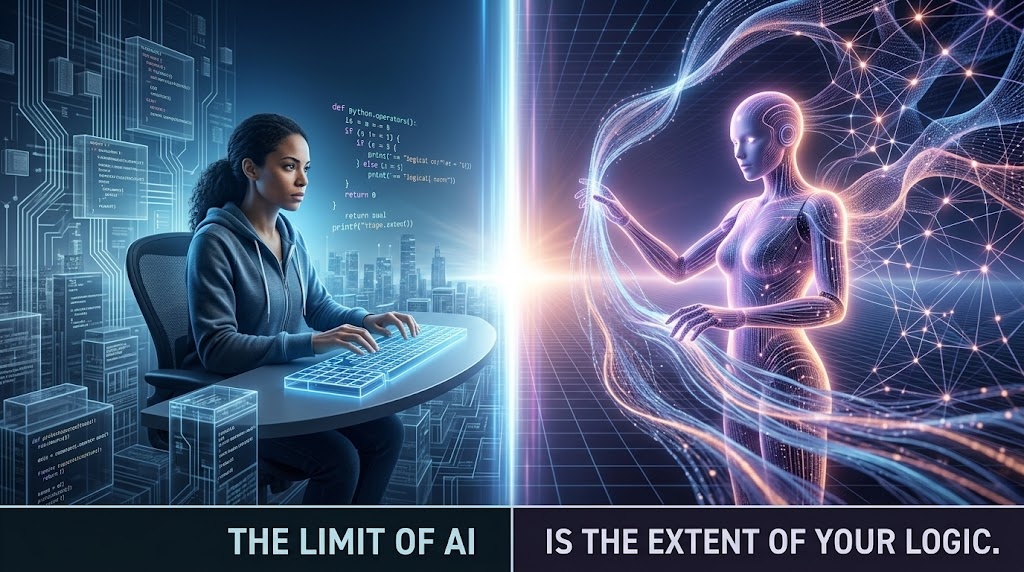
The debate on whether artificial intelligence will replace developers is often framed as a false dilemma: the traditional technical expert versus the average user empowered by an intelligent agent. However, the real friction is neither syntactic nor superficial. It's not about who writes a Python function faster or who sets up an automation flow in half an hour. The real gap is architectural and logical.
1. The illusion of the "no-code maker"
When someone without technical training uses an AI agent to connect a webhook, generate a script, or set up a pipeline that solves a real business problem, they experience an understandable feeling of digital omnipotence.
But it's worth understanding what is happening behind the scenes:
- The invisible architecture: The agent doesn't create out of nothing; it operates within preconceived abstractions, sandboxes, APIs, databases, and protocols meticulously designed by engineers.
- The happy path wall: The user without logical foundations can successfully solve the predictable path. The problem appears with the first edge case: unexpected latencies, concurrency failures, idempotency issues, performance degradation, or security breaches (such as prompt injection or API key leaks).
- The borrowed ceiling: As the conversation aptly summarizes: «their ceiling is only as high as a developer allows». He who does not master the fundamentals is not building autonomous software; he is inhabiting the maneuvering margins that someone else designed for him.
2. Logical thinking is not included in the prompt
The most widespread myth is that AI replaces the need to reason. The reality of modern development proves exactly the opposite: AI brutally exposes those who lack logical judgment.
To solve a complex problem through software (with or without agents), very specific cognitive skills are required:
- Decomposition: Partitioning an ambiguous requirement into elementary, deterministic, and testable premises.
- Abstraction: Understanding which layers should interact and which should remain isolated.
- Failure inference: Anticipating how the system can collapse before it happens in production.
The user who does not possess this mental structure quickly enters a blind loop: they ask the AI to fix an error, the model introduces another, and without criteria to audit the result, the resulting system becomes a house of cards.
3. The uncomfortable question: What about developers?
Here lies the most lucid point of the original discussion: many developers share exactly the same limitation.
For years, the industry tolerated and rewarded the merely repetitive developer: one whose differentiating value lay in memorizing the syntax of a framework, assembling standard endpoints, or copying mechanical patterns from Stack Overflow.
Faced with a language model that spits out functional code in milliseconds, that profile suffers a crisis of relevance identical to that of the user without knowledge:
| Profile | AI / Agent Capability | Structural Limitation |
|---|---|---|
| Non-technical user | Solves specific business problems within delimited environments. | Incapable of auditing security, scale, maintainability, or deep architecture. |
| "Code-monkey" developer | Accelerates boilerplate delivery; delegates routine writing. | Stumbles upon the same logical ceiling if they only memorized recipes without understanding abstractions. |
| Engineer with critical thinking | Orchestrates agents, designs resilient systems, transcends the limits of their memory. | Limited only by computational costs and the physical constraints of the problem. |
The fear of certain developers is real, but not because AI is all-powerful. The fear arises from the discovery that writing syntax was never what made them engineers.
4. Creating tools beyond our own knowledge
«We generate the tools ourselves, and we even start generating tools that go beyond our knowledge. We cannot learn that fast.»
This is the true evolutionary leap. Historically, a programmer could only build that whose complete implementation fit into their working memory.
Today, the symbiosis between abstract thought and autonomous agents allows for:
- Delegating tactical execution and focusing on strategic design.
- Interconnecting complex technical domains without needing to master every technical specification down to the millimeter.
- Elevating the level of abstraction: we no longer program instructions; we program intentions, constraints, tests, and architectures.
Conclusion
Are developers trembling?
Not those who think in systems. Not those who understand transaction compensation, consistency models, security, costs, and business value.
Yes, technical complacency is trembling: both the fantasy of the user who believes they have surpassed engineering by connecting three prompts in an agent, and the arrogance of the programmer who believed their career simply consisted of remembering how to iterate an array.
AI did not democratize engineering; it democratized syntax. Mental architecture remains the only superpower.

About the author
ESTEBAN BURGOS · Forward Deployed Engineer
I build software end to end for startups and companies: websites, platforms and AI solutions. I write about what I learn on real projects.
See my backgroundWant something like this for your company?
Tell Tuki about your idea and get a price range in your currency within minutes.
Keep reading
- Podcast: No more spaghetti code, how SDD-Harness brings order to development with AIThe speed at which artificial intelligences can write code today is astonishing, but it comes with a very high hidden cost: **technical anarchy**. When multiple developers integrate AI agents into their daily workflows in an improvised manner, the result is often inconsistent code, silent regressions, undocumented patches, and an alarming loss of traceability. Ultimately, a new type of **"agentic spaghetti code"** that stifles long-term software maintainability. To solve this problem at its root, I designed **SDD-Harness**, a portable, language-agnostic command-line interface (CLI) framework that implements the **Spec-Driven Development (SDD)** methodology. The premise is as simple as it is inflexible: **no line of code is written without a formal, structured, and pre-validated technical specification**. Below, I share a deep dive into how the tool works and why agent governance is the indispensable step to scale AI-assisted software engineering.
- LangChain in 2026: the key to intelligent chatbots with RAG, tools, and unbeatable UXDiscover what LangChain is and why it has become one of the central pieces for building modern intelligent chatbots. We go over how to combine RAG, chat-tools, and a smooth user experience to create assistants that truly solve problems, not just answer questions.
- Microfrontends in the Agentic Era: Orchestration, SDD and the Beauty of the Monorepo with NxDiscover how microfrontends are transforming software development in the era of shared, SDD-driven agentic systems. We explore the flexibility of building interfaces as independent apps or as apps co-located with their BFFs in a monorepo, orchestration with Nx, and the efficiency of shared code through libraries: a paradigm well worth admiring.
Comments
Be the first to comment.