Microfrontends in the Agentic Era: Orchestration, SDD and the Beauty of the Monorepo with Nx
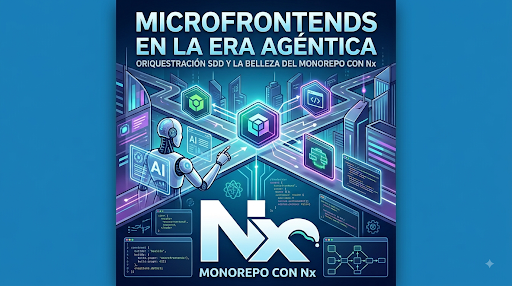
Microfrontends in the Agentic Era: Orchestration, SDD, and the Beauty of the Monorepo with Nx
Modern software development faces increasing complexity. Applications are no longer static monoliths but dynamic ecosystems where multiple services, components, and, increasingly, autonomous "agents" collaborate. In this scenario, microfrontends emerge as an elegant solution to manage UI complexity, especially when combined with the robustness of an Nx-orchestrated monorepo and the clarity of Spec-Driven Development (SDD).
The Promise of Microfrontends
In essence, microfrontends extend the principles of microservices to the client side. Instead of a single monolithic frontend application, we decompose the user interface into smaller, autonomous, and independently deployable parts. Each microfrontend is owned by a team, can be developed with its preferred technology (although consistency is key), and integrates into a main shell to form a cohesive user experience.
The Era of Shared Agentic Systems
Imagine a future, or even a present, where systems not only process data but act as intelligent "agents." These agents can range from highly specialized microservices to autonomous AI components that interact with each other and with users. In this context, the user interface needs to be equally modular and adaptable, capable of reflecting and orchestrating the interactions of these agents, sharing context fluidly and efficiently.
This is where microfrontends shine. They allow different parts of the UI to represent the capabilities of different agents or business domains, facilitating collaboration and autonomy for the teams developing these "agentic pieces" of the system.
Spec-Driven Development (SDD): The Fundamental Contract
For these microfrontends, interacting with agentic systems, to function harmoniously, we need a common language and a clear set of expectations. This is where Spec-Driven Development (SDD) comes in. SDD involves defining a system's interfaces, behaviors, and contracts through detailed specifications before writing any code.
In the world of microfrontends and agentic systems, SDD becomes the backbone that ensures:
- Consistency: Each microfrontend and each agent understands the expected inputs and outputs.
- Collaboration: Teams can develop in parallel, confident that their pieces will fit together thanks to agreed-upon specifications.
- Risk Reduction: Errors are detected earlier, as the design is validated against specifications.
SDD provides the foundation for microfrontends to not only coexist but to collaborate effectively in a complex environment.
Implementation Flexibility: Independent Apps and BFFs in a Monorepo
One of the greatest virtues of microfrontends is their versatility in implementation:
- As Independent Applications: For highly disparate functionalities or teams with very specific technological needs, a microfrontend can be a completely independent app, with its own deployment lifecycle and its own stack. This maximizes team autonomy.
- As Apps Co-located with Their BFFs (Backend For Frontend) in a Monorepo: In the era of agentic systems, BFFs become critical. A BFF accompanies each microfrontend, adapting the backend API to its specific needs, reducing client complexity and optimizing network requests. Having these BFFs alongside their microfrontends in a centralized monorepo is a powerful strategy. It facilitates coherence, discovery, and dependency management between the frontend layers and their direct backend.
Nx: The Masterful Orchestration of the Monorepo
A monorepo can become unmanageable without the right tools. This is where Nx (a smart build system with extensible dev tools for monorepos, offering first-class support for Angular, React, Node, and more) comes into play as a first-class orchestrator. Nx transforms the monorepo into an intelligent workspace, providing:
- Generators and Executors: Tools to quickly create new apps and libraries, and execute standardized tasks (test, build, lint) across the entire workspace.
- Dependency Graph: Nx understands the relationships between its projects (apps and libraries), enabling incremental builds and optimizing task executions. If only a microfrontend or a shared library changes, Nx will only recompile what is necessary.
- Consistency: It enforces standards, which is vital for maintaining quality and maintainability in a diverse ecosystem of microfrontends and BFFs.
The ability to have multiple microfrontends and their associated BFFs in the same monorepo, efficiently orchestrated by Nx, is a testament to the evolution of modern development.
The Heavy Lifting of Shared Code Through Libraries: A Beauty to Behold
While independence is key, code duplication is the enemy. This is where the ability to create and manage shared libraries within the monorepo, enabled by Nx, becomes truly beautiful. Imagine:
- UI Components: A consistent design system implemented in a component library that all microfrontends can consume.
- Utilities: Helper functions, validators, formatters that avoid constant reimplementation.
- Reusable Business Logic: Encapsulated and shared according to the chosen stack (for example, custom hooks in React).
- Data Models and Types: Ensuring data consistency between the frontend and the BFF, and with the SDD specifications.
This approach not only drastically reduces code duplication but also fosters consistency in the user experience and maintainability. A change in a central library propagates to all consumers, ensuring that improvements and fixes benefit the entire system centrally. It is, without a doubt, heavy lifting, but the result — an efficient, coherent system — more than justifies the effort: a beauty to behold.
Conclusion
The combination of microfrontends, shared agentic systems, Spec-Driven Development, the flexibility of independent apps and BFFs, and Nx's orchestration along with shared code libraries represents a powerful architecture for the future of software development. It allows us to build complex systems in a more agile, scalable, and maintainable way, adapting to the demands of an increasingly interconnected and modular digital world. This paradigm not only optimizes the development process but also elevates the quality and consistency of the final user experience.

About the author
ESTEBAN BURGOS · Frontend Tech Lead · End-to-End Solutions Engineer
I build software end to end for startups and companies: websites, platforms and AI solutions. I write about what I learn on real projects.
See my backgroundWant something like this for your company?
Tell Tuki about your idea and get a price range in your currency within minutes.
Keep reading
- Trading with AI: why in my system the backtest decides and the LLM only vetoesHow I designed Crypto Trader, a multi-agent system for trading BTC and ETH on Binance where decisions come from backtest-calibrated rules and the AI can only veto. Eight agent roles, models chosen by score, and risk and testnet gates before production.
- One Year of Tucu UI: Lessons from Maintaining an Open Source Design SystemA year maintaining Tucu UI, my open source React component library with macOS-style layout variants. I share the API design, documentation, and versioning decisions behind it, and what I would do differently.
- Microfrontends with Nx, Part 2: How to Split Domains, Version Contracts, and Survive CI in a Real-World CaseA more practical second part: how we split domains in an Nx monorepo with microfrontends, what contracts we defined between them, how we versioned them, and what got complicated in CI as it grew. Decisions, trade-offs and takeaways.
Comments
Be the first to comment.